
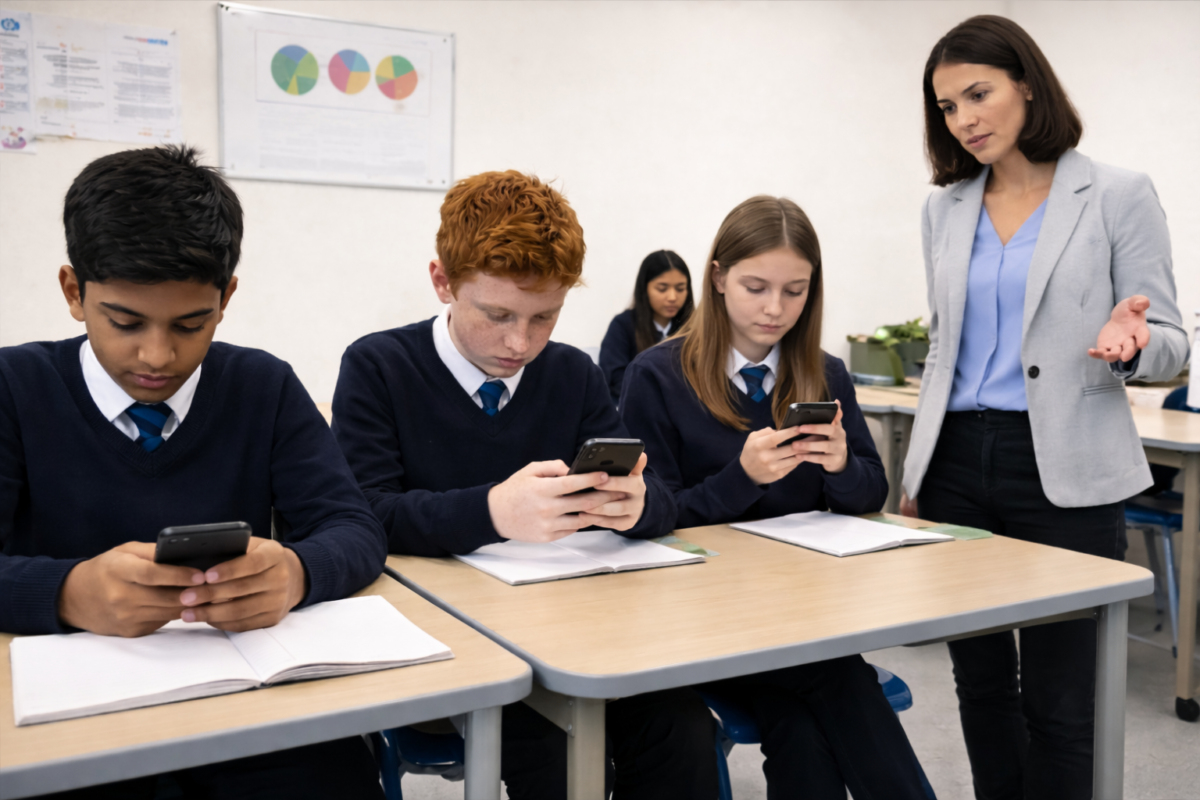
The conversation around Phone Free Schools has shifted significantly over the past two years. What was once a school-level behaviour decision is now closely aligned with national guidance and inspection expectations.
For governors and senior leadership teams (SLT), this raises an important strategic question:
What will Ofsted expect to see when inspecting our mobile phone policy — and how do we demonstrate that it is effective?
This inspection-focused guide explains:
- How Phone Free Schools link to the Ofsted framework
- What inspectors are likely to ask about your mobile phone policy
- How behaviour, safeguarding and culture intersect
- What evidence schools should provide
- Common implementation risks
- How structured systems such as secure phone pouch models support inspection readiness
If you are searching for information on:
- Ofsted mobile phone policy
- Phone Free Schools Ofsted expectations
- Mobile phones Ofsted inspection
- School phone ban inspection framework
This guide is written specifically for governors, trustees and SLT.
Why Phone Free Schools Now Matter in Ofsted Inspections
There is no statute banning mobile phones in schools in England. However, national guidance makes clear that schools are expected to operate as phone-free environments by default.
Ofsted has stated that inspectors will discuss a school’s mobile phone policy, how it is implemented, and whether pupils and staff understand expectations. From April 2026, inspectors are expected to consider:
- Whether a clear policy exists
- Whether it is consistently applied
- Whether pupils understand expectations
- The impact on behaviour and learning
Phone Free Schools is no longer just a behavioural preference. It is a leadership and culture issue.
For governors and SLT, mobile phone policy now intersects with:
- Behaviour and attitudes
- Safeguarding
- Leadership and management
- Personal development
Where Mobile Phone Policy Sits Within the Ofsted Framework
Behaviour and Attitudes
This is the most immediate link.
Inspectors evaluate:
- Low-level disruption
- Focus in lessons
- Respect for routines
- Conduct between lessons
- Behaviour during break and lunchtime
If phones are visible, regularly confiscated, or openly used in corridors, inspectors may question the effectiveness of your policy.
A strong Phone Free Schools approach supports:
- Calm corridors
- Clear boundaries
- Reduced distraction
- Improved classroom focus
Safeguarding
Mobile phone use intersects with safeguarding risks such as:
- Online bullying during the school day
- Image-sharing incidents
- Social media disputes escalating into school
- Coercion or exploitation concerns
Inspectors may explore:
- Whether your policy reduces safeguarding risk
- How incidents are logged and escalated
- Whether DSL procedures align with behaviour sanctions
In inspection dialogue, Phone Free Schools is as much a safeguarding strategy as a behaviour strategy.
Leadership and Management
Inspectors assess whether leaders:
- Have a clear rationale
- Apply policy consistently
- Support staff
- Consider workload
- Monitor impact
Governors should be able to explain:
- Why this mobile phone policy model was chosen
- How it aligns with national guidance
- How its effectiveness is reviewed
A lack of strategic oversight can weaken inspection confidence.
What Inspectors May Ask Governors
Governors should prepare for questions such as:
- Why did you adopt this Phone Free Schools approach?
- How does it align with national expectations?
- What impact has it had on behaviour?
- How do you ensure consistent enforcement?
- How are reasonable adjustments managed?
- What feedback have you received from staff and parents?
- How do you know the policy is working?
If governors cannot confidently answer these, inspectors may question leadership coherence.
Evidence Inspectors Will Look For
Inspection-ready schools can demonstrate measurable impact.
Behaviour Data
- Reduction in phone-related incidents
- Fewer confiscations over time
- Improved corridor behaviour
Staff Feedback
- Improved focus in lessons
- Reduced daily confrontation
- Lower enforcement fatigue
Pupil Voice
- Increased social interaction at break
- Less screen dependency during school hours
Documentation
- Published mobile phone policy
- Clear sanctions structure
- Defined reasonable adjustment process
- Communication records to parents
Inspection success is not about having the strictest ban.
It is about having a coherent, consistently applied system with measurable impact.
Inconsistency: The Biggest Inspection Risk
Inconsistency is one of the most common inspection weaknesses.
Examples include:
- Some staff enforcing strictly while others overlook breaches
- Phones visible in corridors despite a “ban”
- Sixth formers openly using devices in shared areas
- Staff modelling poor practice
If your Phone Free Schools policy exists only in writing but not in daily routine, inspectors will notice.
Consistency matters more than severity.
Why Implementation Matters to Ofsted
Inspectors are not interested only in policy wording. They will observe:
- How pupils comply
- How staff enforce
- Whether the system reduces confrontation
- Whether routines are sustainable
This makes implementation models inspection-relevant.
Comparing Implementation Models Through an Inspection Lens
Off and Away Model
Phones remain in bags.
Risks from an inspection perspective:
- Hard to monitor
- Frequent low-level breaches
- Ongoing teacher intervention
Inspectors may observe subtle use and question policy effectiveness.
Central Collection Model
Phones handed in at the start of the day.
Strengths:
- Clear removal of access
Risks:
- Logistical complexity
- Storage disputes
- Time impact at arrival
Locker Storage Model
Phones stored securely during the day.
Strengths:
- Clear structure
Risks:
- Supervision gaps
- Ongoing access concerns
Secure Phone Pouch Systems
Pupils keep phones but cannot access them during the school day.
From an inspection perspective, this approach can:
- Demonstrate visible compliance
- Reduce daily enforcement conflict
- Create a predictable routine
- Address parental travel concerns
Secure pouch systems such as Clario support schools in embedding Phone Free Schools consistently and visibly.
Inspectors are not prescribing a specific method. They are evaluating whether your chosen method works.
Sixth Form Considerations
If sixth form pupils have limited access, inspectors may ask:
- Why is this distinction made?
- Does it undermine lower-school expectations?
- Are there defined boundaries?
If access is permitted, it should be:
- Restricted to specific areas
- Limited to defined times
- Clearly enforced
Ambiguity weakens inspection confidence.
Staff Modelling and Professional Conduct
Inspectors may observe staff practice as part of evaluating culture.
Visible personal phone use by staff during duty can undermine:
- Policy credibility
- Behaviour expectations
- Leadership consistency
Your Phone Free Schools policy should clarify staff expectations to support consistent modelling.
Safeguarding Alignment
Inspectors may explore how phone-related incidents connect to safeguarding systems.
Strong inspection dialogue may include evidence such as:
- Reduction in school-day online bullying incidents
- Clear escalation pathways
- Integration with safeguarding logs
Phone Free Schools strengthens safeguarding when implemented strategically.
Communication Strategy and Inspection Confidence
Inspectors may ask:
- How was the policy communicated?
- Was there consultation?
- How were parental concerns addressed?
Effective communication includes:
- Advance notice
- Clear rationale
- FAQ documentation
- Travel safety reassurance
- Termly reminders
Clear communication strengthens inspection narratives.
Measuring Impact: Turning Policy into Evidence
Inspection-ready schools track measurable outcomes such as:
- Phone-related behaviour logs per term
- Safeguarding referrals linked to phone misuse
- Staff workload feedback
- Student engagement surveys
Governors should review this data regularly.
Without measurable impact, Phone Free Schools may appear symbolic rather than strategic.
Frequently Asked Questions About Ofsted and Phone Free Schools
Is a full ban required?
There is no statutory ban. However, guidance expects schools to operate as phone-free by default. Inspectors will assess impact rather than mandate a specific model.
Can inspectors criticise our approach?
Inspectors do not prescribe systems. They evaluate effectiveness, consistency and impact on learning and behaviour.
What if we allow limited access?
Be prepared to explain:
- Why
- Where
- When
- How misuse is prevented
Clarity and consistency protect inspection outcomes.
Governance Checklist for Inspection Readiness
Governors should confirm:
- Clear written mobile phone policy
- Consistent enforcement routines
- Defined exemption process
- Alignment with safeguarding
- Measurable impact data
- Staff support mechanisms
- Strong communication strategy
If these elements are present, Phone Free Schools becomes an inspection strength.
From Inspection Risk to Strategic Advantage
The key shift for governors and SLT is reframing the discussion.
Instead of asking:
“What will Ofsted think about our phone ban?”
Ask:
“Does our mobile phone policy strengthen behaviour, safeguard pupils and improve learning — and can we evidence that?”
When implemented effectively, Phone Free Schools can:
- Reduce low-level disruption
- Improve classroom focus
- Strengthen safeguarding
- Reduce staff workload
- Increase inspection confidence
Consistency, clarity and measurable impact are what inspectors will ultimately evaluate.